

The Benefits of Biodynamic Ingredients in Weleda Products Explain Weleda’s farming philosophy, sustainability, and why it matters.

🌿 Biodynamic Beauty • Weleda Philosophy The Benefits of Biodynamic Ingredients in Weleda Products Why soil, rhythm, plant wisdom, sustainability and human wellbeing all matter when you choose natural skincare — and how Weleda’s biodynamic roots show up in much-loved products such as Skin Food and Calendula care. Shop Skin Food 100 Years Meet Mark, Your Weleda Advocate Biodynamic Weleda garden illustration A stylised biodynamic garden with calendula, chamomile, bees, sun, moon and a Skin Food tube. Skin Food Calendula • Chamomile Biodynamic ingredients are not simply “natural ingredients with a nicer label”. In Weleda’s world, they represent a whole way of thinking about the relationship between soil, plants, people and the wider living environment. A calendula flower is not treated as an isolated raw material. It is understood as part of a living garden: the soil that feeds it, the insects that visit it, the seasons that shape it, the hands that harvest it, and the purpose it will serve in a carefully made product. That is why biodynamic farming matters so much to Weleda. It connects skincare to something deeper than texture, fragrance and packaging. It asks a bigger question: what kind of agriculture should stand behind the products we use every day on our skin? For Weleda, the answer has always been rooted in respect — respect for the earth, respect for plant life, respect for the human being, and respect for the rhythms of nature. When you pick up a product such as Skin Food, or choose a gentle Calendula product for delicate skin, you are not only choosing a cream, balm or wash. You are touching a story that reaches back to medicinal plant gardens, anthroposophic ideas, and a belief that true beauty should never be separated from health, sustainability and responsibility. What does biodynamic farming mean? Biodynamic agriculture is often described as an advanced form of organic growing, but that description only tells part of the story. Like organic farming, biodynamic growing avoids synthetic pesticides and artificial fertilisers. But it goes further by viewing the farm or garden as a whole living organism. Soil, compost, animals, plants, trees, water, insects and human care are all seen as interdependent. In practical terms, this means biodynamic growers work to build living soil, create biodiversity, reduce dependency on external inputs, and cultivate plants in harmony with natural rhythms. Compost is not treated as waste, but as a living source of fertility. Habitats are created for pollinators and beneficial insects. Seed saving, careful harvesting and soil preparation become part of a wider ecological responsibility. Living soil Biodynamic practice starts with fertile, active soil. Healthy soil is not a background detail; it is the foundation of resilient plants and responsible skincare sourcing. Biodiversity Flowers, hedges, meadows and insect-friendly spaces help create balance. A biodynamic garden aims to be alive with relationships, not stripped into a monoculture. Natural rhythms Biodynamics pays attention to cycles: day and night, seasons, growth and rest. The result is a slower, more observant form of agriculture. For skincare customers, this matters because the quality of a plant extract begins long before it reaches the laboratory or the product jar. It begins in the way the plant was grown. A biodynamic ingredient carries the intention of the whole process: careful cultivation, ecological awareness, respect for the living landscape and a refusal to separate product quality from environmental quality. Weleda’s farming philosophy: in harmony with nature and the human being Weleda was founded in 1921, and medicinal plants have been central to its identity from the beginning. The company’s approach is built on the idea that human health and the health of nature belong together. This is why Weleda’s gardens are not just decorative spaces or marketing symbols. They are working medicinal plant gardens where cultivation, observation and sustainability meet. In a biodynamic garden, the aim is not to dominate nature but to collaborate with it. That shift in attitude is important. Modern agriculture often focuses on maximum output, standardisation and speed. Biodynamic cultivation asks for attentiveness instead: what does this soil need, what is this plant expressing, what rhythms are present, and how can the garden become more self-sustaining over time? Weleda’s philosophy therefore has both a practical and ethical dimension. Practically, it supports traceable, carefully grown botanicals. Ethically, it recognises that the beauty industry cannot talk about “natural skincare” while ignoring the land from which nature is taken. A truly natural product should not exhaust the natural world that provides it. Why this matters: biodynamic skincare is about joined-up thinking. It brings together ingredient quality, soil health, biodiversity, responsible sourcing, product formulation and a more conscious relationship with nature. This is one reason Weleda has such a strong identity. The brand is not simply chasing the latest skincare trend. It has a philosophical backbone. The same values that guide its cultivation of calendula, chamomile, rosemary, arnica, birch and other plants also guide the way it speaks about human wellbeing: gently, holistically and with respect for the whole person. Anthroposophy, Rudolf Steiner and Ita Wegman To understand Weleda properly, it helps to understand the word anthroposophy. Anthroposophy is the philosophical and spiritual movement associated with Rudolf Steiner. It is concerned with the human being as more than a purely mechanical body. It looks at life, health, development, education, agriculture, art and medicine through the lens of relationship, meaning and inner growth. Rudolf Steiner’s ideas influenced biodynamic agriculture, Waldorf education, eurythmy and anthroposophic medicine. In Weleda’s history, these ideas were not abstract theories sitting on a shelf. They became practical: gardens, remedies, skincare, rhythmical processes, and a way of approaching health that pays attention to body, soul and spirit. Dr Ita Wegman is equally important in this story. As a medical doctor, she worked with Steiner in the development of anthroposophic medicine. Where Steiner brought a broad philosophical and spiritual framework, Wegman brought clinical medical experience and a profound interest in treating the individual human being, not merely the isolated symptom. Their collaboration helped shape the
Weleda & Hay Fever: Natural Seasonal Support for Pollen-Heavy Days
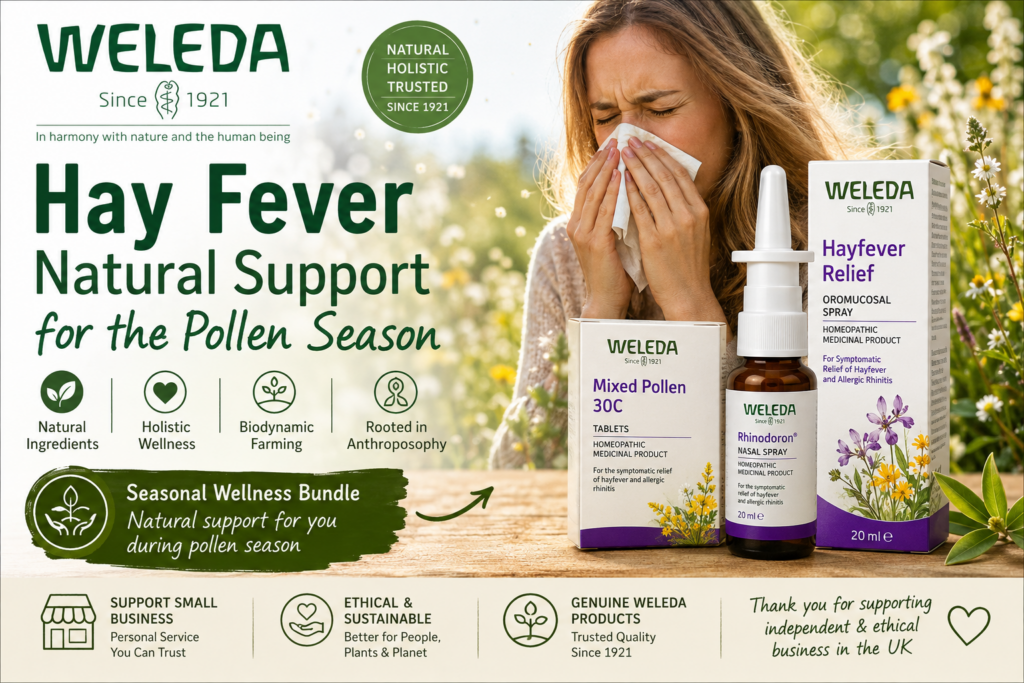
Seasonal Wellness • Hay Fever • Weleda Natural Medicines Weleda & Hay Fever: Natural Seasonal Support for Pollen-Heavy Days Spring and summer should feel like an invitation: longer walks, garden days, sea air, sunshine, open windows and flowers in bloom. But for hay fever sufferers, pollen season can turn those beautiful months into a cycle of sneezing, blocked noses, itchy eyes, tiredness and constant tissue-hunting. If that sounds familiar, this article is for you. Weleda Seasonal Wellness Bundle — three natural seasonal essentials in one easy set. 🌿 Shop the Seasonal Wellness Bundle When Hay Fever Gets in the Way of Real Life Hay fever is one of those seasonal concerns that can sound minor until you are the one living with it. A high pollen day can affect your work, sleep, mood, exercise, social life and ability to enjoy being outdoors. It can make you feel foggy and tired. It can make your eyes water when you are trying to concentrate. It can make your nose feel dry, irritated, blocked or constantly runny. And because pollen season can stretch across several months, many people are not looking for a one-off product. They are looking for a seasonal routine that feels gentle enough to use regularly and practical enough to keep with them. That is where Weleda’s seasonal approach is so helpful. Instead of thinking about hay fever as one isolated symptom, Weleda’s natural medicine tradition looks at the whole person: the nose, the eyes, the breathing, the body’s rhythm, daily exposure to pollen and the way the season affects wellbeing as a whole. This is very much in keeping with Weleda’s wider philosophy: nature, human health and daily care all belong together. At BROOLED’s Weleda Shop, I have created a simple seasonal solution for customers who want to be ready before pollen-heavy days arrive: the Weleda Seasonal Wellness Bundle. It brings together three carefully chosen Weleda products that work beautifully as a seasonal toolkit: Rhinodoron Nasal Spray, Hayfever Relief Oromucosal Spray and Mixed Pollen 30C Tablets. 🌼 The Seasonal Wellness Bundle: Your Weleda Hay Fever Toolkit The Seasonal Wellness Bundle is designed for the months when pollen is high and your body needs extra care. It is a convenient way to have the main Weleda seasonal support products together, rather than buying them one by one or waiting until symptoms have already disrupted your day. The bundle contains: 🌿 Rhinodoron Nasal Spray 20ml — a natural nasal spray with aloe vera and isotonic saline solution to moisturise, cleanse and care for dry nasal passages. 🌸 Hayfever Relief Oromucosal Spray 20ml — a homeopathic medicinal product used within the homeopathic tradition for the symptomatic relief of hay fever and other forms of allergic rhinitis. 🌾 Mixed Pollen 30C Tablets — a homeopathic medicinal product for seasonal symptoms, traditionally recommended by homeopaths as part of a seasonal routine. For many customers, the real benefit of the bundle is simplicity. Pollen season can be unpredictable. One day you feel fine, the next day the air is warm, windy and heavy with pollen. Having a ready-to-use seasonal kit at home, in your bag or in your bathroom cabinet gives you one less thing to think about when symptoms begin. 🛒 Add the Bundle to Your Basket 1. Rhinodoron Nasal Spray: Gentle Care for Dry, Irritated Noses Rhinodoron Nasal Spray 20ml One of the most frustrating parts of hay fever season is nasal discomfort. Your nose can feel blocked, dry, crusty, irritated or overworked from constant blowing. Rhinodoron Nasal Spray is a gentle, natural way to care for the nasal passages during pollen season. It contains a natural saline solution with organic aloe vera, designed to moisturise, cleanse and care for dry nasal passages. The formulation is simple and purposeful. Rhinodoron contains sodium chloride and potassium chloride in an isotonic solution, alongside aloe vera gel and water for injections. In plain English, that means it helps support daily nasal hygiene without feeling harsh. The aloe vera adds a soothing, moisturising quality, while the saline solution helps clean and care for the inside of the nose. This makes Rhinodoron a very practical product during pollen season. It can be used when the pollen count is high, when the air feels dry, after being outdoors, or as part of a morning and evening seasonal routine. It is suitable for vegans and can be used for daily nasal hygiene over longer periods, always following the product label and leaflet. For customers who want one product to start with, Rhinodoron is often the easiest entry point. It is not complicated, it is not messy and it fits into everyday life. Keep it by the sink, in your work bag, beside your bed or wherever you are most likely to remember to use it. Shop Rhinodoron Nasal Spray 20ml → 2. Hayfever Relief Oromucosal Spray: Pocket-Sized Homeopathic Support Weleda Hayfever Relief Oromucosal Spray is a pocket-sized homeopathic medicinal product used within the homeopathic tradition for the symptomatic relief of hay fever and other forms of allergic rhinitis. It is designed for adults, the elderly and children over 12 years of age, and it is especially useful for people who want something portable and quick to use when symptoms start. Unlike a nasal spray, this product is sprayed directly into the mouth. That makes it easy to carry and use throughout the day, whether you are commuting, gardening, walking, travelling, working or spending time outdoors. It is small enough to keep in your pocket or bag, which is exactly what you want during unpredictable pollen days. The active homeopathic ingredients are Allium cepa 6X, Euphrasia officinalis 6X and Gelsemium sempervirens 6X. Within the homeopathic tradition, these ingredients are associated with the kinds of symptoms many people recognise during hay fever season, including streaming eyes, runny nose, sneezing and that general seasonal discomfort that can make you feel worn down. Allium cepa is red onion. Anyone who has chopped an onion knows how quickly it can bring on watery eyes