

From Ashes to Anthroposophia
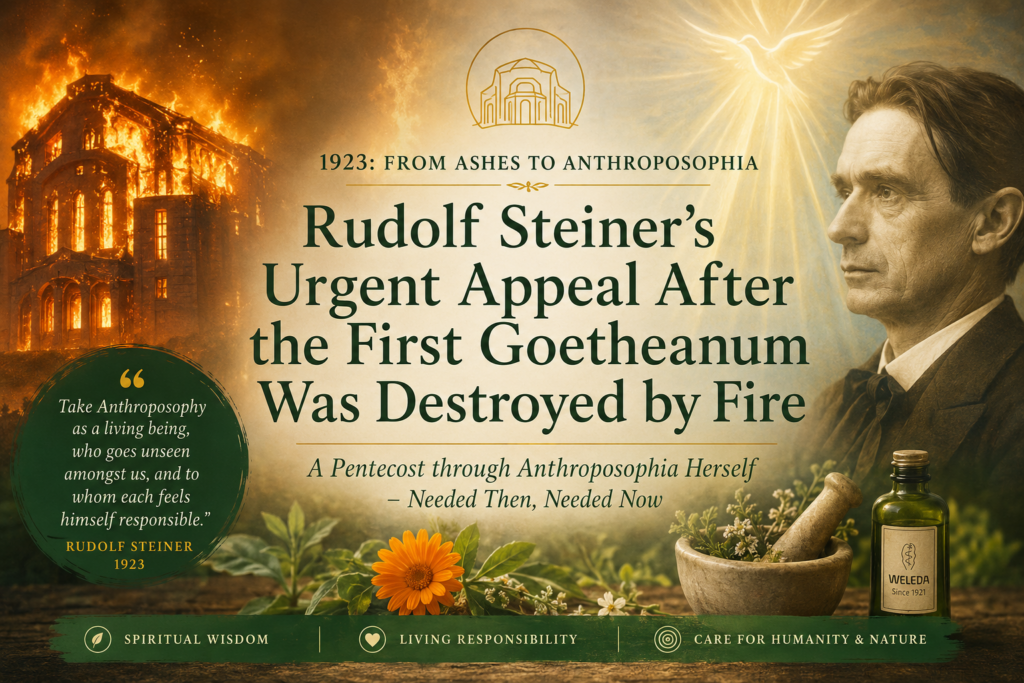
Anthroposophy, Weleda & the Living Spirit From Ashes to Anthroposophia: The First Goetheanum, Pentecost, and the Living Spirit Behind Weleda In 1923, after the First Goetheanum was destroyed by fire, Rudolf Steiner called members of the Anthroposophical Society away from mere outward activity and toward a living connection with the spiritual worlds. That appeal still speaks today — to seekers, gardeners, healers, makers, and everyone who senses that true care must be rooted in spirit as well as nature. Shop my BROOLED Weleda Store Visit my official Weleda Advocate page The First Goetheanum in Dornach before the fire. Image: Wikimedia Commons / public domain. There are moments in spiritual history when an outer event becomes more than an event. A building falls, a community is shaken, and something that once stood visibly in wood, colour, carved form, and shared labour must be rediscovered inwardly. The burning of the First Goetheanum in Dornach on New Year’s Eve 1922/23 was such a moment. For those who had worked, travelled, studied, performed, prayed, and sacrificed around the Goetheanum, the loss was not simply architectural. It was intimate. The building had gathered years of devotion. It had been intended as a home for a new kind of culture: art, science, spiritual research, medicine, education, agriculture, social renewal, and human self-knowledge. When the flames consumed it, they also tested whether anthroposophy could remain alive when its most visible form had disappeared. Rudolf Steiner’s response was striking. He did not ask members of the Anthroposophical Society merely to look outward, rebuild administratively, or be consumed by external opposition. He urged them to forge a connection with the radiant spiritual light of the heavenly worlds. He asked them to relate to anthroposophy not as a doctrine to possess, nor as an organisation to manage, but as a living being: unseen among them, asking for responsibility. That appeal feels powerfully contemporary. We live in a time of constant external noise: notifications, crises, brand activity, organisational busyness, and never-ending commentary. Steiner’s 1923 challenge asks something deeper. Can a movement, a shop, a medicine, a garden, a product, a ritual of care, or a community remain connected to its living spiritual source? Can we still recognise wisdom when the outer container changes? Fire The burning of the Goetheanum was an outer catastrophe, but also a spiritual test for the movement around it. Anthroposophia Anthroposophy was to be taken not merely as teaching, but as a living spiritual presence asking for responsibility. Weleda Weleda belongs to this wider stream: a practical expression of reverence for nature, rhythm, body, soul, and spirit. The Night the Visible Form Was Lost The First Goetheanum had been built in Dornach, Switzerland, through years of remarkable collaboration. It was not designed as a conventional hall. Its rounded forms, double domes, carved columns, painted ceilings, coloured glass, and living sculptural language were intended to make anthroposophy visible. In the Goetheanum, idea and form were not separate. Architecture became a gesture. Art became a path of knowledge. Space became a teacher. The building was destroyed by fire during the night of 31 December 1922 into 1 January 1923. The shock was immense. The Goetheanum had carried the labour of many hands and the hopes of a movement. It was linked with the founding impulses of Waldorf education, biodynamic agriculture, anthroposophic medicine, eurythmy, the arts, and a renewed spiritual understanding of the human being. Yet Steiner’s answer to the catastrophe was not despair. He recognised the pain, but he also pointed beyond the ruin. If the building had been a vessel of love, that love could not be reduced to ash. It had to be sought now in Spirit. What had been outside had to be awakened inside. The ruins of the First Goetheanum after the fire. Image: Wikimedia Commons / public domain. Anthroposophy: Anthropos and Sophia The word anthroposophy is often translated as “wisdom of the human being”. The Greek anthropos points to the human being; Sophia points to wisdom. But the word is richer when approached imaginatively. It suggests that the human being is not complete merely by existing physically, socially, or intellectually. The human being becomes whole by being filled with wisdom — not abstract cleverness, but living, divine, cosmic wisdom. In this sense, the First Goetheanum was more than a cultural centre. It was an attempt to give artistic form to the meeting of Anthropos and Sophia: the human being standing open to cosmic wisdom. Its architecture was not meant to decorate anthroposophy from the outside. It was meant to express a living relationship between the human being and the spiritual worlds. When the Goetheanum burned, the question became unavoidable: had anthroposophy lived only in the building, or could it live in human hearts? Was it a structure, or was it a being? Was it a programme, or was it a responsibility? Steiner’s challenge still matters: external work without inner fire becomes administration. Inner experience without responsible action becomes private mysticism. The living middle is spiritual connection that becomes moral responsibility. Steiner’s Urgent Appeal In January 1923, Steiner spoke with urgency to the members. The Society could not survive merely through outer activity. Rebuilding, fundraising, lectures, committees, and programmes had their place, but they were not the centre. The centre was the inner bond with spiritual reality. That is why his appeal to connect with the radiant spiritual light of the heavenly worlds is so important. He was not recommending escapism. He was not telling people to ignore the world. He was asking them to find the spiritual centre from which meaningful earthly work can proceed. The phrase “living being” is equally significant. To take anthroposophy as a living being means that we do not treat it as a museum, a slogan, or a closed belief system. A living being asks to be met. A living being changes the one who encounters it. A living being asks for care, truthfulness, humility, courage, and devotion. This is perhaps one of the great tests for any
Weleda Arnica: A Natural Favourite for Active Bodies, Recovery Rituals and Everyday Wellbeing
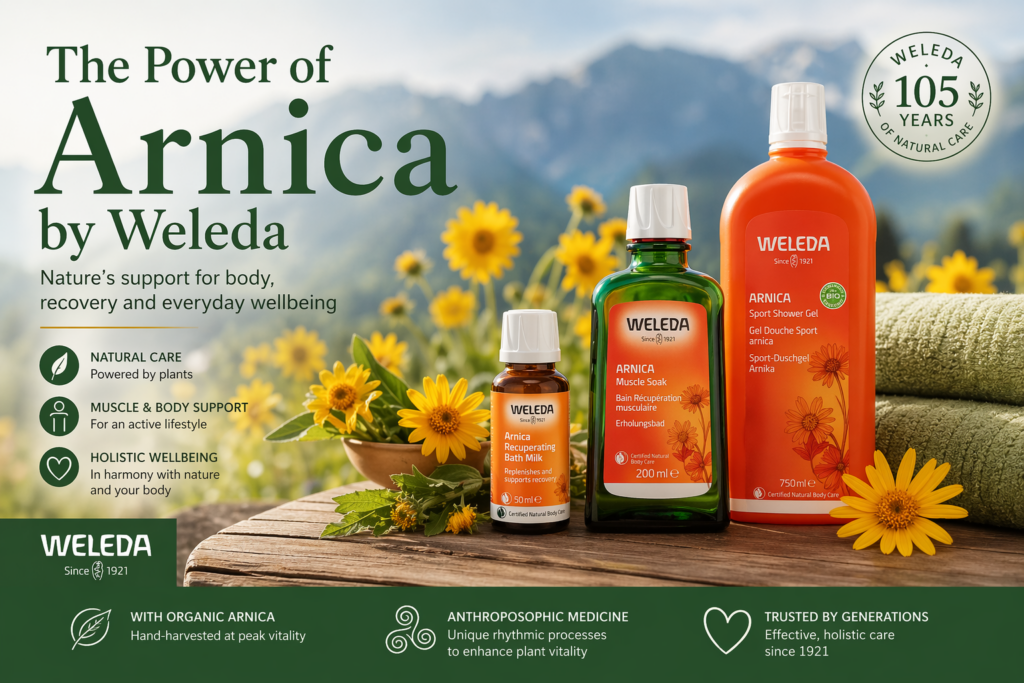
The Power of Arnica by Weleda Nature’s support for body, recovery and everyday wellbeing For nearly a century, Weleda has worked in harmony with nature to create effective, holistic care. Among our most treasured botanical allies is Arnica montana – a mountain plant with remarkable traditional use and a proud place in natural health. In this guide, I’ll share the story of arnica – in homeopathy, in anthroposophic medicine, and in Weleda’s skincare and body care. You’ll discover our arnica bath and shower products, how they can support your active lifestyle, and why your support means the world for a small business like mine. What is Arnica? Arnica montana is a hardy yellow-flowered plant native to the mountain regions of Europe. It thrives in alpine meadows at high altitude, where the air is pure and the growing conditions are demanding – much like the plant itself. Arnica has a long tradition of use in folk medicine for bumps, bruises, muscle fatigue and overexertion. Shop Arnica Products Explore the full range of Weleda Arnica products: Arnica Products Browse all Weleda products: Weleda Store Arnica Recuperating Bath Milk 50ml View Product A compact way to enjoy the Weleda Arnica bath ritual. Arnica Muscle Soak 200ml View Product A restorative soak for tired, overworked muscles and weary limbs. Arnica Sport Shower Gel 750ml View Product Fresh, energising body care for active daily routines. Arnica in Homeopathy In homeopathy, Arnica montana is one of the most commonly used remedies, often associated with bruising, soreness and post-exertion recovery within that tradition. It is distinct from cosmetic and body-care products, which use botanical extracts for external use. Arnica Used by Weleda At Weleda, arnica features in carefully designed body-care formulas that support active lifestyles and recovery rituals. It brings together botanical tradition, sensory care and a practical everyday use. Arnica in Anthroposophic Medicine Weleda’s roots are closely connected with anthroposophic medicine, a holistic approach that sees body, mind and spirit as interconnected. Arnica is valued in that tradition for its relationship with vitality, movement and recovery after physical strain. BROOLED Independent Weleda Store Natural wellness, thoughtful service, and products chosen with care. Supporting a Small Business – Supporting Real People My faithful customers in Europe and the USA cannot shop via my Weleda Advocate website. But you can buy your favourite Weleda products in my own Weleda Store: https://weleda.brooled.co.uk As a small business owner and Weleda Ambassador, your support means a great deal. Thank you for being here. Weleda’s Anniversary in 2026 In 2026, Weleda marks 105 years since its 1921 beginnings. 100 Years of Skin Food Skin Food reaches its 100-year milestone in 2026, celebrating its original 1926 launch. Tags: Weleda Arnica, Arnica Products, Weleda body care, Arnica Muscle Soak, Arnica Recuperating Bath Milk, Arnica Sport Shower Gel, homeopathy, anthroposophic medicine, Weleda anniversary 2026, Skin Food 100 years
Dr. Ita Wegman: Pioneer of Anthroposophic Medicine and Holistic Healing
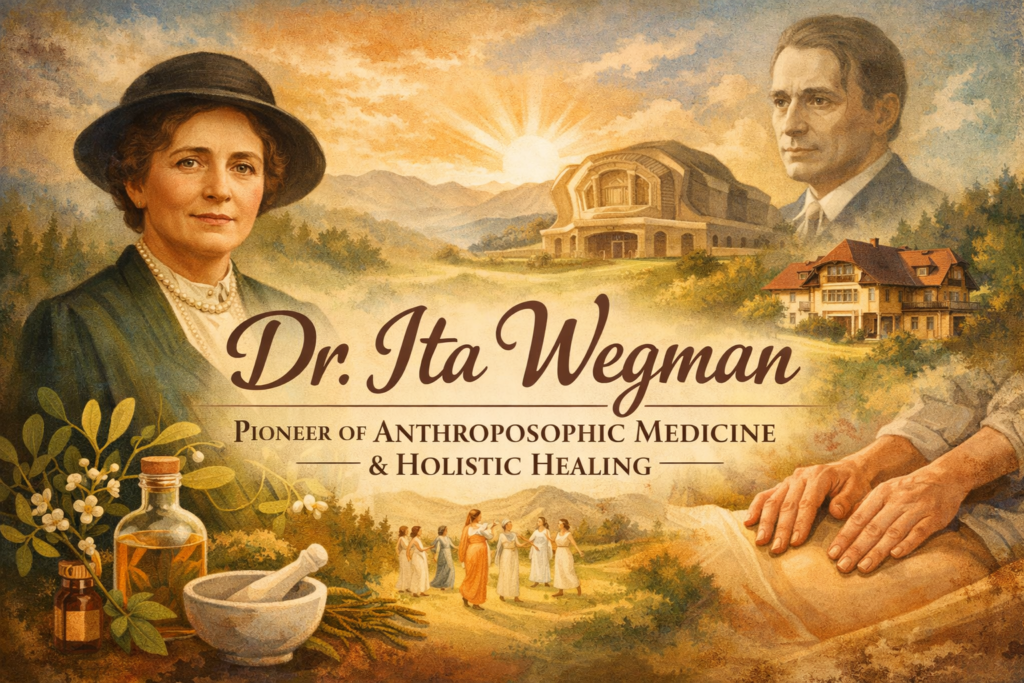
Dr. Ita Wegman (1876–1943) stands as one of the most visionary women in the history of medicine — a courageous physician whose work reshaped medical practice through a holistic understanding of human health and healing. Introduction In a world dominated by conventional scientific medicine, Dr. Ita Wegman introduced a bold alternative — one that integrated physical, emotional, and spiritual dimensions into healing. Her work laid the foundation for anthroposophic medicine, a distinct approach that still resonates globally nearly a century later. But who was Ita Wegman? How did she transition from a Dutch colonial upbringing in Southeast Asia to becoming a trailblazer in holistic health? This article explores her life, influences, challenges, and lasting legacy. Early Life: From Java to Europe Maria Ita Wegman was born on 22 February 1876 in Karawang, West Java — then part of the Dutch East Indies — as the eldest child in a Dutch colonial family. Her early years in Indonesia were shaped by travel and education, including private lessons and boarding school in the Netherlands before adulthood. As a young woman, Wegman experienced a profound personal loss when her fiancé died of lung disease. This tragedy marked a turning point, deepening her interest in spiritual questions and ultimately influencing her future direction toward healing and wellness. At the turn of the 20th century, she relocated to Europe and trained in therapeutic gymnastics and massage, first in Holland and then in Berlin — at a time when women were beginning to enter medical and therapeutic professions but still faced serious barriers. Meeting Rudolf Steiner: Conception of a New Path In 1902, a chance encounter changed the course of her life: Wegman met Rudolf Steiner, the philosopher and founder of anthroposophy — a spiritual and scientific worldview that emphasized the interconnectedness of body, mind, and spirit. Steiner encouraged Wegman to pursue formal medical training, a suggestion she would take seriously. Motivated by Steiner’s ideas, Wegman entered the University of Zurich in 1906, where women were permitted to study medicine — something still rare elsewhere. She excelled and graduated in 1911 with a medical diploma, specializing in women’s health and gynecology. During this period, she also established her first medical practice, developing an integrative approach that blurred distinctions between physical and psychosocial care — a foundation for her future work in anthroposophic medicine. Developing Anthroposophic Medicine The First Clinic By 1917, Wegman had opened her own practice in Zurich, where she began experimenting with therapies inspired by Steiner’s suggestions. Most notably, she developed a treatment for cancer using a mistletoe extract, initially called Iscar — which evolved into Iscador, one of the earliest anthroposophic medicinal preparations. While modern scientific evidence does not conclusively support mistletoe as a curative cancer therapy, Wegman’s work was revolutionary for its time, emphasizing improved quality of life and holistic patient care. Even today, mistletoe preparations are among the most widely recognized complementary cancer therapies in parts of Europe. In 1920, Wegman purchased land in Arlesheim, Switzerland, and the next year established the Klinisch-Therapeutisches Institut — the first clinic dedicated to anthroposophic medicine. This clinic brought together physicians and therapists committed to a comprehensive model of healing. Innovations in Therapeutic Practice Holistic Therapies and Methods Beyond medicine, Wegman introduced a range of therapeutic innovations. She developed rhythmical massage, which became a cornerstone of anthroposophic physical therapy, emphasizing rhythmic, gentle movement to promote systemic balance. Her interdisciplinary vision also embraced artistic and expressive therapies — including eurythmy, painting, music, and speech therapy — all seen as integral to fostering health in body and soul. These methods laid the groundwork for what later became recognized as anthroposophic therapeutic arts. Importantly, she saw the patient as more than a disease; she viewed illness as part of a person’s developmental journey — a concept that redefined therapeutic goals away from symptom suppression toward deeper support of human vitality. Weleda and Expansion of Therapeutic Medicine One of Wegman’s lasting institutional legacies was her role in founding Weleda in 1921, alongside chemist Oskar Schmiedel and others. Originally conceived to produce medications and remedies for the Arlesheim clinic, Weleda grew into a major manufacturer of health and wellness products, still guided by holistic principles. Under her leadership, the clinical therapeutic institute and Weleda pioneered the production of botanical medicines and preparations rooted in anthroposophic philosophy. Wegman’s talents for leadership, vision, and practical implementation were crucial in ensuring these early ventures secured financial stability and long-term success. Teaching and Leadership Medical Journal and Writings Wegman was not only a practitioner but also a communicator. In the mid-1920s, she founded Natura, a medical journal that became an important forum for anthroposophic medical thought and research. Together with Steiner, she authored key texts such as Extending Practical Medicine — originally published as Fundamentals of Therapy — offering theoretical foundations for anthroposophic medical practices. These works helped shape a coherent framework that practitioners around the world could reference and build upon. Role at the Goetheanum In 1923, Steiner appointed Wegman to the Executive Council of the newly reorganized General Anthroposophical Society and director of its medical section at the Goetheanum, the movement’s central research institution. In this role, she helped integrate spiritual science with medical theory and practice. Wegman also provided dedicated personal care to Steiner in his final illness before his death in 1925, forging one of the most important partnerships in the history of anthroposophy. Humanitarian Vision and Social Engagement Wegman’s concern extended beyond institutions to people in need. In 1922, she founded Haus Sonnenhof, a therapeutic home for children with developmental disabilities, applying anthroposophic principles to education and care. Her work was animated by a deep compassion for “fringe groups” often marginalized by society. Particularly in the 1930s, she helped many individuals facing persecution — including Jewish people escaping Nazi Germany — evidencing her commitment to human dignity and social justice. Conflict and Final Years Despite her successes, Wegman’s relationship with the Anthroposophical Society became strained. In 1935, disagreements with other members of the Executive Council led to her