

From Ashes to Anthroposophia: The First Goetheanum, Pentecost, and the Living Spirit Behind Weleda
In 1923, after the First Goetheanum was destroyed by fire, Rudolf Steiner called members of the Anthroposophical Society away from mere outward activity and toward a living connection with the spiritual worlds. That appeal still speaks today — to seekers, gardeners, healers, makers, and everyone who senses that true care must be rooted in spirit as well as nature.
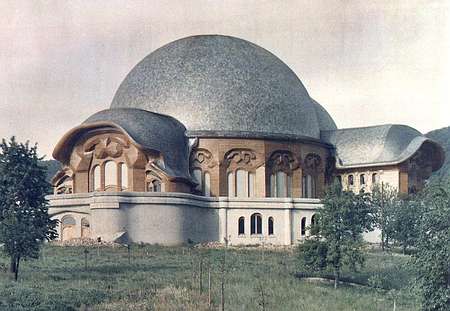
There are moments in spiritual history when an outer event becomes more than an event. A building falls, a community is shaken, and something that once stood visibly in wood, colour, carved form, and shared labour must be rediscovered inwardly. The burning of the First Goetheanum in Dornach on New Year’s Eve 1922/23 was such a moment.
For those who had worked, travelled, studied, performed, prayed, and sacrificed around the Goetheanum, the loss was not simply architectural. It was intimate. The building had gathered years of devotion. It had been intended as a home for a new kind of culture: art, science, spiritual research, medicine, education, agriculture, social renewal, and human self-knowledge. When the flames consumed it, they also tested whether anthroposophy could remain alive when its most visible form had disappeared.
Rudolf Steiner’s response was striking. He did not ask members of the Anthroposophical Society merely to look outward, rebuild administratively, or be consumed by external opposition. He urged them to forge a connection with the radiant spiritual light of the heavenly worlds. He asked them to relate to anthroposophy not as a doctrine to possess, nor as an organisation to manage, but as a living being: unseen among them, asking for responsibility.
That appeal feels powerfully contemporary. We live in a time of constant external noise: notifications, crises, brand activity, organisational busyness, and never-ending commentary. Steiner’s 1923 challenge asks something deeper. Can a movement, a shop, a medicine, a garden, a product, a ritual of care, or a community remain connected to its living spiritual source? Can we still recognise wisdom when the outer container changes?
Fire
The burning of the Goetheanum was an outer catastrophe, but also a spiritual test for the movement around it.
Anthroposophia
Anthroposophy was to be taken not merely as teaching, but as a living spiritual presence asking for responsibility.
Weleda
Weleda belongs to this wider stream: a practical expression of reverence for nature, rhythm, body, soul, and spirit.
The Night the Visible Form Was Lost
The First Goetheanum had been built in Dornach, Switzerland, through years of remarkable collaboration. It was not designed as a conventional hall. Its rounded forms, double domes, carved columns, painted ceilings, coloured glass, and living sculptural language were intended to make anthroposophy visible. In the Goetheanum, idea and form were not separate. Architecture became a gesture. Art became a path of knowledge. Space became a teacher.
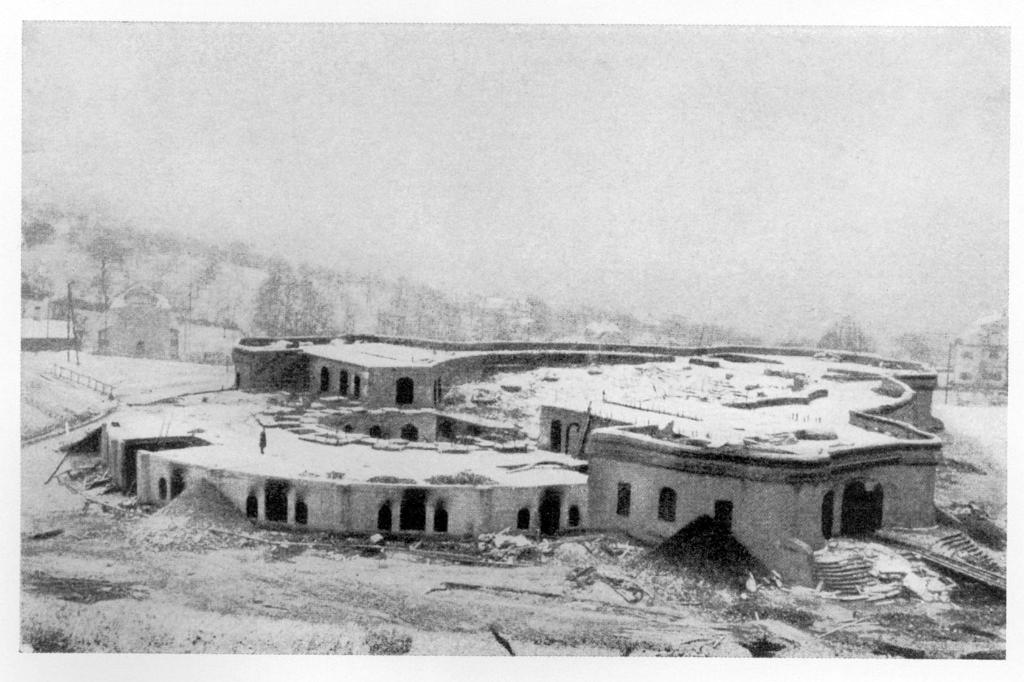
The building was destroyed by fire during the night of 31 December 1922 into 1 January 1923. The shock was immense. The Goetheanum had carried the labour of many hands and the hopes of a movement. It was linked with the founding impulses of Waldorf education, biodynamic agriculture, anthroposophic medicine, eurythmy, the arts, and a renewed spiritual understanding of the human being.
Yet Steiner’s answer to the catastrophe was not despair. He recognised the pain, but he also pointed beyond the ruin. If the building had been a vessel of love, that love could not be reduced to ash. It had to be sought now in Spirit. What had been outside had to be awakened inside.
Anthroposophy: Anthropos and Sophia
The word anthroposophy is often translated as “wisdom of the human being”. The Greek anthropos points to the human being; Sophia points to wisdom. But the word is richer when approached imaginatively. It suggests that the human being is not complete merely by existing physically, socially, or intellectually. The human being becomes whole by being filled with wisdom — not abstract cleverness, but living, divine, cosmic wisdom.
In this sense, the First Goetheanum was more than a cultural centre. It was an attempt to give artistic form to the meeting of Anthropos and Sophia: the human being standing open to cosmic wisdom. Its architecture was not meant to decorate anthroposophy from the outside. It was meant to express a living relationship between the human being and the spiritual worlds.
When the Goetheanum burned, the question became unavoidable: had anthroposophy lived only in the building, or could it live in human hearts? Was it a structure, or was it a being? Was it a programme, or was it a responsibility?
Steiner’s challenge still matters: external work without inner fire becomes administration. Inner experience without responsible action becomes private mysticism. The living middle is spiritual connection that becomes moral responsibility.
Steiner’s Urgent Appeal
In January 1923, Steiner spoke with urgency to the members. The Society could not survive merely through outer activity. Rebuilding, fundraising, lectures, committees, and programmes had their place, but they were not the centre. The centre was the inner bond with spiritual reality.
That is why his appeal to connect with the radiant spiritual light of the heavenly worlds is so important. He was not recommending escapism. He was not telling people to ignore the world. He was asking them to find the spiritual centre from which meaningful earthly work can proceed.
The phrase “living being” is equally significant. To take anthroposophy as a living being means that we do not treat it as a museum, a slogan, or a closed belief system. A living being asks to be met. A living being changes the one who encounters it. A living being asks for care, truthfulness, humility, courage, and devotion.
This is perhaps one of the great tests for any spiritual or ethical movement. Does it become an institution that preserves its name, or does it remain a living presence that renews human beings?
A Pentecost Through Anthroposophia Herself
The image of Pentecost is deeply relevant here. In the Christian tradition, Pentecost is the descent of the Holy Spirit: a moment when scattered individuals become inwardly kindled and able to speak across boundaries. It is an event of fire, language, courage, community, and spiritual understanding.
After the Goetheanum fire, Steiner’s appeal can be understood as a call for a new Pentecost — not merely through outer speech, but through Anthroposophia herself. The members needed a living spiritual presence among them, one that could awaken responsibility in each individual heart. The old visible centre had been consumed. A new invisible centre had to be recognised.
This is why the destruction of the Goetheanum can be read not only as tragedy, but as initiation. The question after the fire was not simply, “How do we rebuild the building?” It was also, “How do we become worthy of the being whose name we speak?”
That question still matters.
We can apply it today to anthroposophy, to Weleda, to biodynamic gardening, to conscious commerce, and to our own self-care. When we use words such as natural, holistic, ethical, biodynamic, spiritual, sustainable, or conscious, do those words still carry fire? Or have they become labels? Do they ask something of us? Do they call us into responsibility?
From Spiritual Science to Everyday Care
Weleda stands within this wider stream. Founded in 1921, Weleda arose from the collaboration of Rudolf Steiner, Dr Ita Wegman, and Oskar Schmiedel. Its beginnings were connected with anthroposophic medicine, natural substances, clinical work, pharmacy, and a view of the human being as body, soul, and spirit.
That matters because Weleda products are not simply “natural” in the fashionable sense. They belong to a heritage that sees the plant, the soil, the season, the body, and the human being as interrelated. The plant is not treated merely as an ingredient. It is observed, understood, cultivated, and formulated within a wider picture of life.
This does not mean we should make exaggerated claims. A cream is still a cream. A bath milk is still a bath milk. A body oil is still a body oil. But when made with integrity, such things can become part of a culture of care. They can remind us that the body is not a machine. Skin is not a surface to be conquered. Rest is not laziness. Rhythm is not old-fashioned. Nature is not a warehouse of raw material.
In that sense, everyday care can become a quiet continuation of a much larger impulse. We may not all be architects, doctors, farmers, or spiritual researchers. Yet we can ask: how do I meet the world? How do I care for my body? How do I choose what I buy? How do I support businesses and traditions that try to honour life?

The Goetheanum as Inner Architecture
One of the most moving ways to understand the loss of the First Goetheanum is to see it as a call to build inwardly. The original building had been an outer architecture of spiritual striving. After the fire, the members were asked to become bearers of an inner architecture.
An inner Goetheanum is built whenever thought becomes more truthful, feeling becomes more reverent, and action becomes more responsible. It is built when people refuse to let spiritual life become merely decorative. It is built when practical work is warmed by meaning.
This is not grandiose. It is very practical. A customer choosing a product with care is participating in a different economy from one driven only by speed and disposability. A gardener building soil is participating in a different relationship with the earth. A reader trying to understand anthroposophy with openness rather than prejudice is participating in a different kind of thinking. A small shop owner curating products, writing articles, and serving customers honestly is also part of that field of responsibility.
The question becomes: what do we allow to live through our work?
Why This Matters Now
The modern world often separates everything: medicine from agriculture, business from ethics, body from soul, science from spirituality, convenience from consequence. Anthroposophy, at its best, resists that fragmentation. It asks us to perceive relationships.
The First Goetheanum tried to embody relationship. Architecture, speech, movement, colour, sound, and community were gathered into one living artistic whole. Its burning made visible the fragility of outer forms. But it also revealed something stronger: an impulse cannot be destroyed if it is inwardly taken up.
That is why Steiner’s 1923 appeal still speaks. It warns us against relying only on external signs of success. A beautiful website, a busy shop, a full calendar, or an impressive organisation can all be useful, but none of them is the source. The source is living connection: to truth, to nature, to Spirit, and to the human beings we serve.
For a Weleda customer, this may sound lofty, but it can become beautifully simple. Choose with attention. Learn the story behind the product. Notice the plant. Create a daily rhythm. Support ethical supply chains where possible. Read, question, and deepen. Let self-care become not vanity, but gratitude for incarnation.
Anthroposophia and the Human Future
To speak of Anthroposophia as a living being is to speak poetically, spiritually, and responsibly. It does not require forcing belief on anyone. It invites reverence. It asks us to consider that wisdom is not something humans manufacture alone. Wisdom may also approach us, call us, and ask to be received.
The First Goetheanum was intended to help human beings stand in that reception. Its forms suggested metamorphosis: the possibility that life develops, transforms, and rises into higher expression. Its destruction forced the community to ask whether metamorphosis could happen in them.
That is the deeper Pentecost. Not fire falling upon a building, but fire awakening in human beings. Not language as noise, but language as understanding. Not community as membership list, but community as shared responsibility for a living spiritual task.
This is where the theme returns to us. Every generation must rediscover the source. We cannot inherit living anthroposophy merely as information. We must meet it, test it, love it, question it, and make it fruitful in the present.
A Note for Modern Readers
It is worth approaching this history with both devotion and discernment. Anthroposophy can sound strange when it is reduced to unfamiliar terminology. Yet many of its practical fruits are very familiar: a child-centred school, a farm treated as a living organism, a medicine that asks about the whole person, an architecture shaped by movement rather than dead geometry, and skincare that respects the rhythms of nature.
The point is not to romanticise the past. The early anthroposophical movement had its human difficulties, disagreements, blind spots, and institutional struggles. The people around Steiner were not saints floating above history. They were human beings trying to carry something demanding through a Europe marked by war, economic instability, cultural conflict, and spiritual uncertainty.
That actually makes the 1923 appeal more relevant, not less. Steiner did not ask for a fantasy community without problems. He asked people to become inwardly awake enough to bear responsibility. He asked them not to hide behind committees, slogans, or admiration. The living being of anthroposophy could only be served by living human beings.
The Practical Path of Attention
For me, one of the most helpful ways to bring this into daily life is attention. Attention is a spiritual act before it is a productivity tool. When we pay attention, we stop consuming the world automatically. We notice texture, origin, rhythm, intention, and consequence.
This is why a simple Weleda routine can be more than a routine. Warming a body oil in the hands, choosing a bath milk after a physically demanding day, using a balm on dry skin, or reading the story of a lead plant can become a small act of reconnection. The product is not magic. The attention is part of the healing culture.
The same is true of reading. When we read about the Goetheanum, we are not merely gathering facts. We are asking what kind of humanity could imagine such a building, what kind of courage continued after it burned, and what kind of inner fire might be asked of us now.
Shopping With Meaning: Two Ways to Support My Weleda Work
If this article has helped you feel the deeper roots behind Weleda, I warmly invite you to explore the products through one of my two Weleda shopping links.
Official Weleda Advocate Page
My official Weleda Advocate page is the direct Advocate shopping route. It is ideal when you want to buy through the official Weleda Advocate channel while supporting my work as your Weleda Advocate.
My BROOLED Weleda Store
My own WELEDA shop is my independent BROOLED Weleda store experience. This is where I can combine product guidance, blog articles, curated categories, customer support, and my own shop structure in one place.
The difference is simple: the Advocate page connects you with the official Weleda Advocate shopping route; my BROOLED Weleda shop gives you my own curated store and content experience. Both links support my Weleda work.
Continuing the Journey
If you would like to explore the wider world behind this article, I recommend reading my related posts on biodynamic gardening, Weleda’s history, Dr Ita Wegman, and the Weleda Arnica tradition. Together, they show how anthroposophy moved into agriculture, medicine, body care, and everyday wellbeing.
The burning of the First Goetheanum reminds us that the most precious things cannot be preserved merely by protecting their outer forms. A building can burn. A brand can be misunderstood. A tradition can be reduced to slogans. But a living impulse can be renewed wherever human beings take responsibility for it.
That is the challenge and the hope. Anthroposophy is not merely behind us as history. Anthroposophia can still be before us as invitation.
May we meet her not only in books and buildings, but in the way we think, the way we care, the way we shop, the way we garden, the way we speak, and the way we serve.
Sources & Further Reading
This article is written for reflection and education. For deeper study, visit:
About The Author
