

From Ashes to Anthroposophia
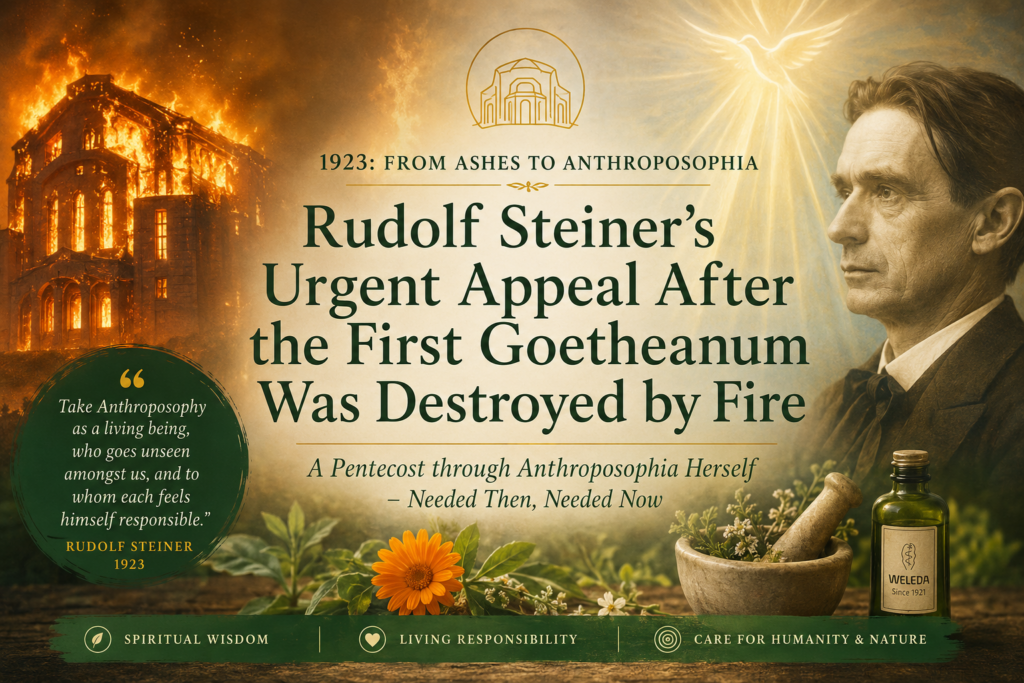
Anthroposophy, Weleda & the Living Spirit From Ashes to Anthroposophia: The First Goetheanum, Pentecost, and the Living Spirit Behind Weleda In 1923, after the First Goetheanum was destroyed by fire, Rudolf Steiner called members of the Anthroposophical Society away from mere outward activity and toward a living connection with the spiritual worlds. That appeal still speaks today — to seekers, gardeners, healers, makers, and everyone who senses that true care must be rooted in spirit as well as nature. Shop my BROOLED Weleda Store Visit my official Weleda Advocate page The First Goetheanum in Dornach before the fire. Image: Wikimedia Commons / public domain. There are moments in spiritual history when an outer event becomes more than an event. A building falls, a community is shaken, and something that once stood visibly in wood, colour, carved form, and shared labour must be rediscovered inwardly. The burning of the First Goetheanum in Dornach on New Year’s Eve 1922/23 was such a moment. For those who had worked, travelled, studied, performed, prayed, and sacrificed around the Goetheanum, the loss was not simply architectural. It was intimate. The building had gathered years of devotion. It had been intended as a home for a new kind of culture: art, science, spiritual research, medicine, education, agriculture, social renewal, and human self-knowledge. When the flames consumed it, they also tested whether anthroposophy could remain alive when its most visible form had disappeared. Rudolf Steiner’s response was striking. He did not ask members of the Anthroposophical Society merely to look outward, rebuild administratively, or be consumed by external opposition. He urged them to forge a connection with the radiant spiritual light of the heavenly worlds. He asked them to relate to anthroposophy not as a doctrine to possess, nor as an organisation to manage, but as a living being: unseen among them, asking for responsibility. That appeal feels powerfully contemporary. We live in a time of constant external noise: notifications, crises, brand activity, organisational busyness, and never-ending commentary. Steiner’s 1923 challenge asks something deeper. Can a movement, a shop, a medicine, a garden, a product, a ritual of care, or a community remain connected to its living spiritual source? Can we still recognise wisdom when the outer container changes? Fire The burning of the Goetheanum was an outer catastrophe, but also a spiritual test for the movement around it. Anthroposophia Anthroposophy was to be taken not merely as teaching, but as a living spiritual presence asking for responsibility. Weleda Weleda belongs to this wider stream: a practical expression of reverence for nature, rhythm, body, soul, and spirit. The Night the Visible Form Was Lost The First Goetheanum had been built in Dornach, Switzerland, through years of remarkable collaboration. It was not designed as a conventional hall. Its rounded forms, double domes, carved columns, painted ceilings, coloured glass, and living sculptural language were intended to make anthroposophy visible. In the Goetheanum, idea and form were not separate. Architecture became a gesture. Art became a path of knowledge. Space became a teacher. The building was destroyed by fire during the night of 31 December 1922 into 1 January 1923. The shock was immense. The Goetheanum had carried the labour of many hands and the hopes of a movement. It was linked with the founding impulses of Waldorf education, biodynamic agriculture, anthroposophic medicine, eurythmy, the arts, and a renewed spiritual understanding of the human being. Yet Steiner’s answer to the catastrophe was not despair. He recognised the pain, but he also pointed beyond the ruin. If the building had been a vessel of love, that love could not be reduced to ash. It had to be sought now in Spirit. What had been outside had to be awakened inside. The ruins of the First Goetheanum after the fire. Image: Wikimedia Commons / public domain. Anthroposophy: Anthropos and Sophia The word anthroposophy is often translated as “wisdom of the human being”. The Greek anthropos points to the human being; Sophia points to wisdom. But the word is richer when approached imaginatively. It suggests that the human being is not complete merely by existing physically, socially, or intellectually. The human being becomes whole by being filled with wisdom — not abstract cleverness, but living, divine, cosmic wisdom. In this sense, the First Goetheanum was more than a cultural centre. It was an attempt to give artistic form to the meeting of Anthropos and Sophia: the human being standing open to cosmic wisdom. Its architecture was not meant to decorate anthroposophy from the outside. It was meant to express a living relationship between the human being and the spiritual worlds. When the Goetheanum burned, the question became unavoidable: had anthroposophy lived only in the building, or could it live in human hearts? Was it a structure, or was it a being? Was it a programme, or was it a responsibility? Steiner’s challenge still matters: external work without inner fire becomes administration. Inner experience without responsible action becomes private mysticism. The living middle is spiritual connection that becomes moral responsibility. Steiner’s Urgent Appeal In January 1923, Steiner spoke with urgency to the members. The Society could not survive merely through outer activity. Rebuilding, fundraising, lectures, committees, and programmes had their place, but they were not the centre. The centre was the inner bond with spiritual reality. That is why his appeal to connect with the radiant spiritual light of the heavenly worlds is so important. He was not recommending escapism. He was not telling people to ignore the world. He was asking them to find the spiritual centre from which meaningful earthly work can proceed. The phrase “living being” is equally significant. To take anthroposophy as a living being means that we do not treat it as a museum, a slogan, or a closed belief system. A living being asks to be met. A living being changes the one who encounters it. A living being asks for care, truthfulness, humility, courage, and devotion. This is perhaps one of the great tests for any
Weleda & Hay Fever: Natural Seasonal Support for Pollen-Heavy Days
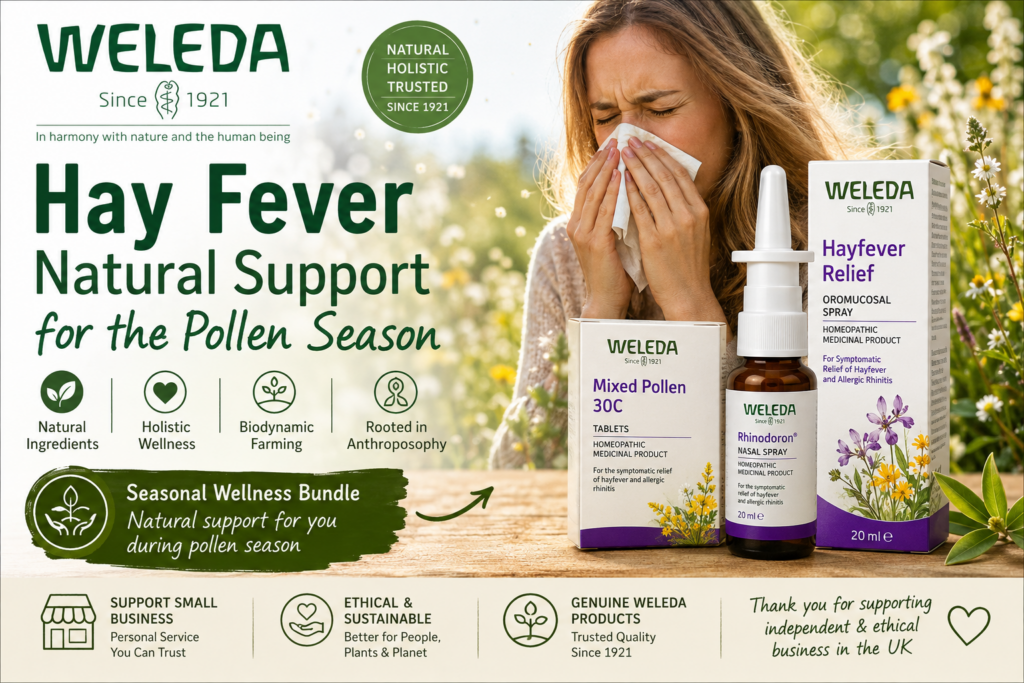
Seasonal Wellness • Hay Fever • Weleda Natural Medicines Weleda & Hay Fever: Natural Seasonal Support for Pollen-Heavy Days Spring and summer should feel like an invitation: longer walks, garden days, sea air, sunshine, open windows and flowers in bloom. But for hay fever sufferers, pollen season can turn those beautiful months into a cycle of sneezing, blocked noses, itchy eyes, tiredness and constant tissue-hunting. If that sounds familiar, this article is for you. Weleda Seasonal Wellness Bundle — three natural seasonal essentials in one easy set. 🌿 Shop the Seasonal Wellness Bundle When Hay Fever Gets in the Way of Real Life Hay fever is one of those seasonal concerns that can sound minor until you are the one living with it. A high pollen day can affect your work, sleep, mood, exercise, social life and ability to enjoy being outdoors. It can make you feel foggy and tired. It can make your eyes water when you are trying to concentrate. It can make your nose feel dry, irritated, blocked or constantly runny. And because pollen season can stretch across several months, many people are not looking for a one-off product. They are looking for a seasonal routine that feels gentle enough to use regularly and practical enough to keep with them. That is where Weleda’s seasonal approach is so helpful. Instead of thinking about hay fever as one isolated symptom, Weleda’s natural medicine tradition looks at the whole person: the nose, the eyes, the breathing, the body’s rhythm, daily exposure to pollen and the way the season affects wellbeing as a whole. This is very much in keeping with Weleda’s wider philosophy: nature, human health and daily care all belong together. At BROOLED’s Weleda Shop, I have created a simple seasonal solution for customers who want to be ready before pollen-heavy days arrive: the Weleda Seasonal Wellness Bundle. It brings together three carefully chosen Weleda products that work beautifully as a seasonal toolkit: Rhinodoron Nasal Spray, Hayfever Relief Oromucosal Spray and Mixed Pollen 30C Tablets. 🌼 The Seasonal Wellness Bundle: Your Weleda Hay Fever Toolkit The Seasonal Wellness Bundle is designed for the months when pollen is high and your body needs extra care. It is a convenient way to have the main Weleda seasonal support products together, rather than buying them one by one or waiting until symptoms have already disrupted your day. The bundle contains: 🌿 Rhinodoron Nasal Spray 20ml — a natural nasal spray with aloe vera and isotonic saline solution to moisturise, cleanse and care for dry nasal passages. 🌸 Hayfever Relief Oromucosal Spray 20ml — a homeopathic medicinal product used within the homeopathic tradition for the symptomatic relief of hay fever and other forms of allergic rhinitis. 🌾 Mixed Pollen 30C Tablets — a homeopathic medicinal product for seasonal symptoms, traditionally recommended by homeopaths as part of a seasonal routine. For many customers, the real benefit of the bundle is simplicity. Pollen season can be unpredictable. One day you feel fine, the next day the air is warm, windy and heavy with pollen. Having a ready-to-use seasonal kit at home, in your bag or in your bathroom cabinet gives you one less thing to think about when symptoms begin. 🛒 Add the Bundle to Your Basket 1. Rhinodoron Nasal Spray: Gentle Care for Dry, Irritated Noses Rhinodoron Nasal Spray 20ml One of the most frustrating parts of hay fever season is nasal discomfort. Your nose can feel blocked, dry, crusty, irritated or overworked from constant blowing. Rhinodoron Nasal Spray is a gentle, natural way to care for the nasal passages during pollen season. It contains a natural saline solution with organic aloe vera, designed to moisturise, cleanse and care for dry nasal passages. The formulation is simple and purposeful. Rhinodoron contains sodium chloride and potassium chloride in an isotonic solution, alongside aloe vera gel and water for injections. In plain English, that means it helps support daily nasal hygiene without feeling harsh. The aloe vera adds a soothing, moisturising quality, while the saline solution helps clean and care for the inside of the nose. This makes Rhinodoron a very practical product during pollen season. It can be used when the pollen count is high, when the air feels dry, after being outdoors, or as part of a morning and evening seasonal routine. It is suitable for vegans and can be used for daily nasal hygiene over longer periods, always following the product label and leaflet. For customers who want one product to start with, Rhinodoron is often the easiest entry point. It is not complicated, it is not messy and it fits into everyday life. Keep it by the sink, in your work bag, beside your bed or wherever you are most likely to remember to use it. Shop Rhinodoron Nasal Spray 20ml → 2. Hayfever Relief Oromucosal Spray: Pocket-Sized Homeopathic Support Weleda Hayfever Relief Oromucosal Spray is a pocket-sized homeopathic medicinal product used within the homeopathic tradition for the symptomatic relief of hay fever and other forms of allergic rhinitis. It is designed for adults, the elderly and children over 12 years of age, and it is especially useful for people who want something portable and quick to use when symptoms start. Unlike a nasal spray, this product is sprayed directly into the mouth. That makes it easy to carry and use throughout the day, whether you are commuting, gardening, walking, travelling, working or spending time outdoors. It is small enough to keep in your pocket or bag, which is exactly what you want during unpredictable pollen days. The active homeopathic ingredients are Allium cepa 6X, Euphrasia officinalis 6X and Gelsemium sempervirens 6X. Within the homeopathic tradition, these ingredients are associated with the kinds of symptoms many people recognise during hay fever season, including streaming eyes, runny nose, sneezing and that general seasonal discomfort that can make you feel worn down. Allium cepa is red onion. Anyone who has chopped an onion knows how quickly it can bring on watery eyes
Biodynamic Gardening, Demeter, Anthroposophy & Weleda: How a Holistic Vision Became a Global Movement
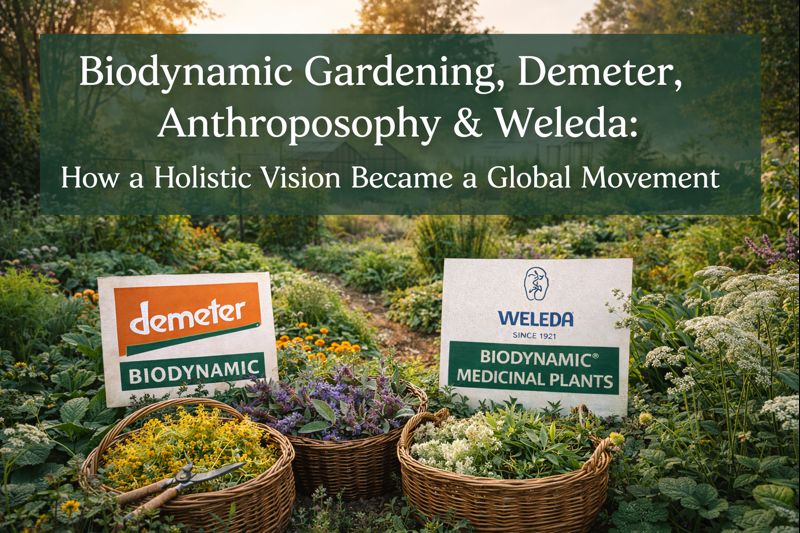
Introduction: A Living System, Not a Product In a world increasingly shaped by industrial agriculture, synthetic inputs, and fragmented approaches to health, a quieter but deeply influential movement has been growing for more than a century. Biodynamic gardening, the Demeter certification, anthroposophy, and the iconic natural health brand Weleda are all expressions of a single, coherent worldview—one that sees soil, plants, animals, humans, and the cosmos as part of an interconnected living system. To many, these names may seem loosely related or even mysterious. Biodynamic gardening is often described as “organic plus,” Demeter is recognized as a rigorous certification label, anthroposophy sounds philosophical or spiritual, and Weleda is known globally for natural skincare and remedies. Yet they are not separate ideas stitched together after the fact. They all originate from the same source and intention: to heal the relationship between humans and nature. This article explores how biodynamic gardening, Demeter, anthroposophy, and Weleda are intrinsically linked—historically, philosophically, and practically—and why their relevance is arguably greater today than ever before. Anthroposophy: The Philosophical Root At the heart of biodynamic gardening, Demeter, and Weleda lies anthroposophy, a holistic philosophy developed by Austrian thinker and social reformer Rudolf Steiner in the early 20th century. Anthroposophy literally means “wisdom of the human being,” and its central aim is to reunite scientific thinking with spiritual insight. Steiner did not reject modern science. Instead, he argued that material science alone was insufficient to understand life. Plants, soils, animals, and humans are not mechanical systems, he suggested, but living beings shaped by invisible forces—rhythms, relationships, and formative energies that can be observed through careful, ethical perception. Anthroposophy expresses itself in many practical fields: In each case, the goal is the same: to support life processes rather than dominate them. In agriculture, this philosophy became biodynamic farming, the first organized ecological agriculture system in the world. Biodynamic Gardening: Agriculture as a Living Organism Origins of Biodynamics Biodynamic gardening began in 1924, when Rudolf Steiner delivered a series of lectures to farmers who were alarmed by declining soil fertility, weaker crops, and loss of seed vitality following the introduction of chemical fertilizers. These lectures—now known as the Agriculture Course—laid the foundation for biodynamic agriculture. Steiner proposed a radical idea for the time: a farm or garden should be understood as a self-contained living organism. Soil, plants, animals, insects, microorganisms, and humans all form a single metabolic system. When balance is restored within this system, fertility and resilience naturally follow. Core Principles of Biodynamic Gardening Biodynamic gardening goes beyond organic practices by integrating ecological, energetic, and cosmic considerations. Its key principles include: Rather than forcing growth, biodynamic gardeners aim to enhance the formative forces of life already present in nature. The Biodynamic Preparations: Nature as Medicine for the Soil One of the most distinctive aspects of biodynamic gardening is the use of nine biodynamic preparations, numbered 500–508. These preparations use medicinal plants such as yarrow, chamomile, nettle, oak bark, dandelion, and valerian, combined with animal substances and carefully timed processes. While often misunderstood or dismissed as mystical, these preparations are used in extremely small quantities—more like homeopathic stimulants for soil life than fertilizers. Their purpose is not to add nutrients, but to activate microbial processes, enhance root–soil relationships, and improve compost maturity. Modern research has increasingly shown that biodynamic soils tend to have: This aligns closely with Weleda’s own approach to medicinal plant cultivation. Demeter: The Gold Standard of Biodynamic Certification As biodynamic farming spread internationally, the need arose to protect its integrity. This led to the creation of Demeter, the world’s oldest ecological certification label, founded in 1928. Named after the Greek goddess of agriculture and fertility, Demeter represents far more than an organic standard. What Makes Demeter Different? Demeter certification requires: Unlike many certifications that focus on inputs, Demeter evaluates the farm as a living whole. Products carrying the Demeter label—whether food, wine, textiles, or cosmetics—must meet rigorous standards from soil to shelf. For conscious consumers, Demeter is a sign of deep ecological commitment rather than surface-level sustainability. Weleda: Anthroposophy in Action Founded in 1921, Weleda is one of the most direct and enduring expressions of anthroposophy in practice. The company was co-founded by Rudolf Steiner, physician Ita Wegman, and chemist Oskar Schmiedel with a clear mission: to create medicines and body care products that support the body’s own healing intelligence. From the beginning, Weleda rejected synthetic chemicals in favor of whole-plant extracts, mineral substances, and rhythmic production processes. This approach mirrored biodynamic principles long before “natural” became a marketing term. Biodynamic Cultivation at Weleda Weleda grows many of its medicinal plants in its own biodynamic gardens around the world, including in Germany, Switzerland, France, and beyond. These gardens are managed according to Demeter standards and biodynamic principles. Key aspects include: This ensures that plant extracts used in Weleda products carry not just chemical constituents, but vitality and integrity. From Garden to Body: A Shared Philosophy What unites biodynamic gardening, Demeter, anthroposophy, and Weleda is a consistent worldview: Biodynamic gardens cultivate plants with stronger root systems, richer aromas, and greater resilience. Demeter ensures these principles are protected at scale. Anthroposophy provides the philosophical foundation. Weleda brings the results into daily human care—through skincare, remedies, and wellness products. In this sense, applying a Weleda product is not just personal care; it is participation in a regenerative system that begins beneath our feet. Why This Matters Today As climate change, soil degradation, and chronic health issues accelerate, the biodynamic–anthroposophical approach offers a compelling alternative. It asks us to slow down, observe, and work with life rather than against it. For gardeners, it offers a way to restore soil and grow nutrient-dense food. For farmers, it provides resilience and independence. For consumers, Demeter and Weleda offer transparency and trust in an often confusing marketplace. Most importantly, this integrated system reminds us that sustainability is not just technical—it is cultural, ethical, and spiritual. Conclusion: One Living Thread Biodynamic gardening, Demeter certification, anthroposophy, and Weleda are not four separate ideas. They are four expressions of one living thread—a holistic vision that recognizes the Earth as a living being and