

The Benefits of Biodynamic Ingredients in Weleda Products Explain Weleda’s farming philosophy, sustainability, and why it matters.
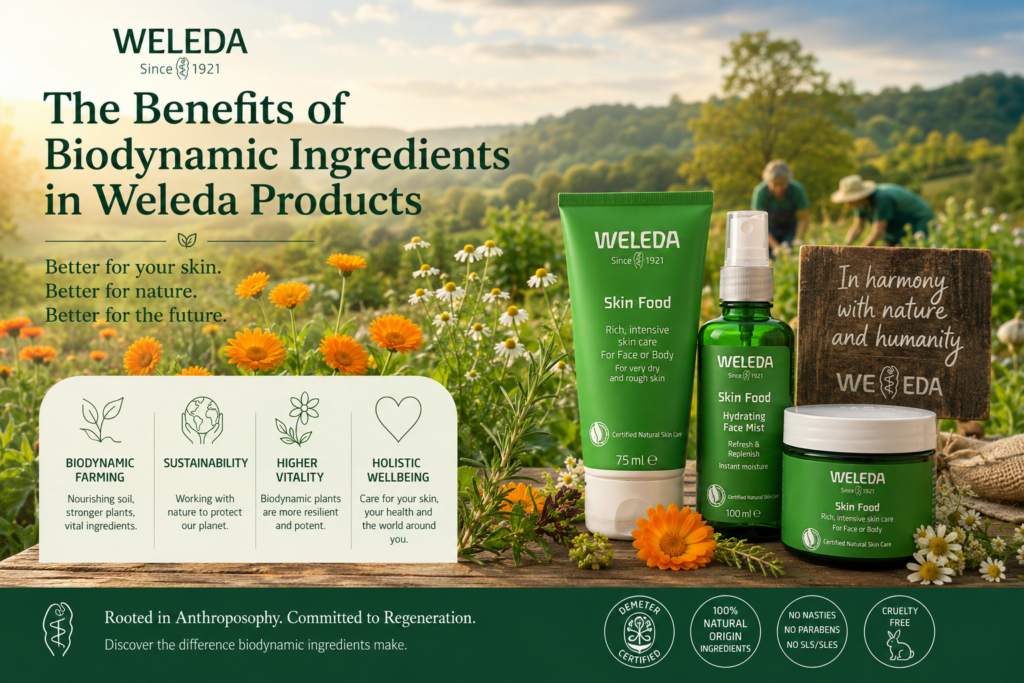
🌿 Biodynamic Beauty • Weleda Philosophy The Benefits of Biodynamic Ingredients in Weleda Products Why soil, rhythm, plant wisdom, sustainability and human wellbeing all matter when you choose natural skincare — and how Weleda’s biodynamic roots show up in much-loved products such as Skin Food and Calendula care. Shop Skin Food 100 Years Meet Mark, Your Weleda Advocate Biodynamic Weleda garden illustration A stylised biodynamic garden with calendula, chamomile, bees, sun, moon and a Skin Food tube. Skin Food Calendula • Chamomile Biodynamic ingredients are not simply “natural ingredients with a nicer label”. In Weleda’s world, they represent a whole way of thinking about the relationship between soil, plants, people and the wider living environment. A calendula flower is not treated as an isolated raw material. It is understood as part of a living garden: the soil that feeds it, the insects that visit it, the seasons that shape it, the hands that harvest it, and the purpose it will serve in a carefully made product. That is why biodynamic farming matters so much to Weleda. It connects skincare to something deeper than texture, fragrance and packaging. It asks a bigger question: what kind of agriculture should stand behind the products we use every day on our skin? For Weleda, the answer has always been rooted in respect — respect for the earth, respect for plant life, respect for the human being, and respect for the rhythms of nature. When you pick up a product such as Skin Food, or choose a gentle Calendula product for delicate skin, you are not only choosing a cream, balm or wash. You are touching a story that reaches back to medicinal plant gardens, anthroposophic ideas, and a belief that true beauty should never be separated from health, sustainability and responsibility. What does biodynamic farming mean? Biodynamic agriculture is often described as an advanced form of organic growing, but that description only tells part of the story. Like organic farming, biodynamic growing avoids synthetic pesticides and artificial fertilisers. But it goes further by viewing the farm or garden as a whole living organism. Soil, compost, animals, plants, trees, water, insects and human care are all seen as interdependent. In practical terms, this means biodynamic growers work to build living soil, create biodiversity, reduce dependency on external inputs, and cultivate plants in harmony with natural rhythms. Compost is not treated as waste, but as a living source of fertility. Habitats are created for pollinators and beneficial insects. Seed saving, careful harvesting and soil preparation become part of a wider ecological responsibility. Living soil Biodynamic practice starts with fertile, active soil. Healthy soil is not a background detail; it is the foundation of resilient plants and responsible skincare sourcing. Biodiversity Flowers, hedges, meadows and insect-friendly spaces help create balance. A biodynamic garden aims to be alive with relationships, not stripped into a monoculture. Natural rhythms Biodynamics pays attention to cycles: day and night, seasons, growth and rest. The result is a slower, more observant form of agriculture. For skincare customers, this matters because the quality of a plant extract begins long before it reaches the laboratory or the product jar. It begins in the way the plant was grown. A biodynamic ingredient carries the intention of the whole process: careful cultivation, ecological awareness, respect for the living landscape and a refusal to separate product quality from environmental quality. Weleda’s farming philosophy: in harmony with nature and the human being Weleda was founded in 1921, and medicinal plants have been central to its identity from the beginning. The company’s approach is built on the idea that human health and the health of nature belong together. This is why Weleda’s gardens are not just decorative spaces or marketing symbols. They are working medicinal plant gardens where cultivation, observation and sustainability meet. In a biodynamic garden, the aim is not to dominate nature but to collaborate with it. That shift in attitude is important. Modern agriculture often focuses on maximum output, standardisation and speed. Biodynamic cultivation asks for attentiveness instead: what does this soil need, what is this plant expressing, what rhythms are present, and how can the garden become more self-sustaining over time? Weleda’s philosophy therefore has both a practical and ethical dimension. Practically, it supports traceable, carefully grown botanicals. Ethically, it recognises that the beauty industry cannot talk about “natural skincare” while ignoring the land from which nature is taken. A truly natural product should not exhaust the natural world that provides it. Why this matters: biodynamic skincare is about joined-up thinking. It brings together ingredient quality, soil health, biodiversity, responsible sourcing, product formulation and a more conscious relationship with nature. This is one reason Weleda has such a strong identity. The brand is not simply chasing the latest skincare trend. It has a philosophical backbone. The same values that guide its cultivation of calendula, chamomile, rosemary, arnica, birch and other plants also guide the way it speaks about human wellbeing: gently, holistically and with respect for the whole person. Anthroposophy, Rudolf Steiner and Ita Wegman To understand Weleda properly, it helps to understand the word anthroposophy. Anthroposophy is the philosophical and spiritual movement associated with Rudolf Steiner. It is concerned with the human being as more than a purely mechanical body. It looks at life, health, development, education, agriculture, art and medicine through the lens of relationship, meaning and inner growth. Rudolf Steiner’s ideas influenced biodynamic agriculture, Waldorf education, eurythmy and anthroposophic medicine. In Weleda’s history, these ideas were not abstract theories sitting on a shelf. They became practical: gardens, remedies, skincare, rhythmical processes, and a way of approaching health that pays attention to body, soul and spirit. Dr Ita Wegman is equally important in this story. As a medical doctor, she worked with Steiner in the development of anthroposophic medicine. Where Steiner brought a broad philosophical and spiritual framework, Wegman brought clinical medical experience and a profound interest in treating the individual human being, not merely the isolated symptom. Their collaboration helped shape the
From Ashes to Anthroposophia
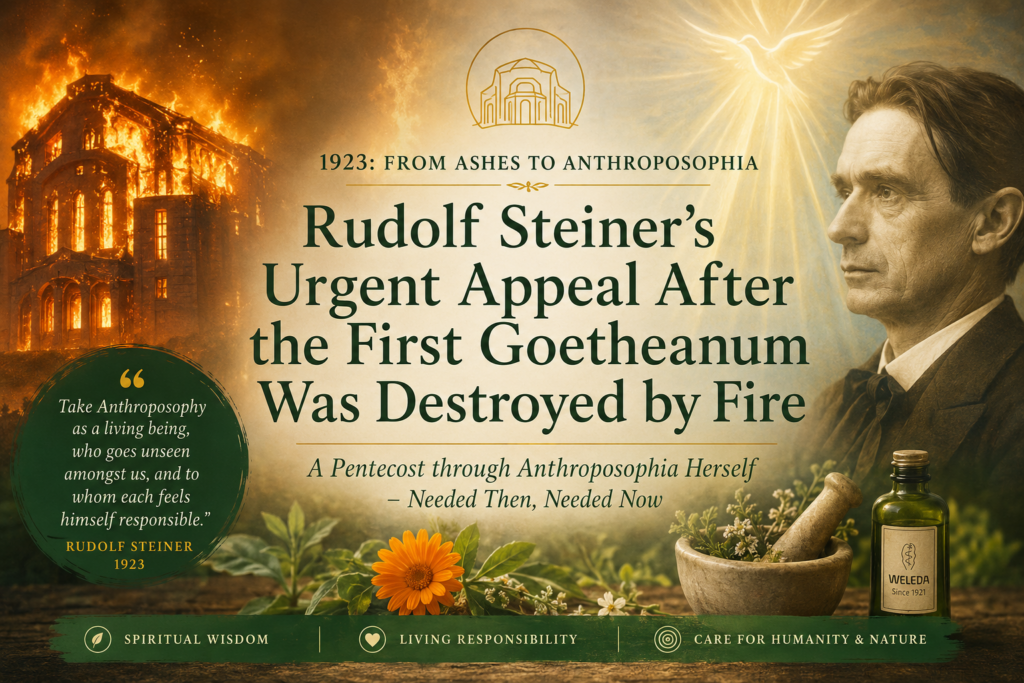
Anthroposophy, Weleda & the Living Spirit From Ashes to Anthroposophia: The First Goetheanum, Pentecost, and the Living Spirit Behind Weleda In 1923, after the First Goetheanum was destroyed by fire, Rudolf Steiner called members of the Anthroposophical Society away from mere outward activity and toward a living connection with the spiritual worlds. That appeal still speaks today — to seekers, gardeners, healers, makers, and everyone who senses that true care must be rooted in spirit as well as nature. Shop my BROOLED Weleda Store Visit my official Weleda Advocate page The First Goetheanum in Dornach before the fire. Image: Wikimedia Commons / public domain. There are moments in spiritual history when an outer event becomes more than an event. A building falls, a community is shaken, and something that once stood visibly in wood, colour, carved form, and shared labour must be rediscovered inwardly. The burning of the First Goetheanum in Dornach on New Year’s Eve 1922/23 was such a moment. For those who had worked, travelled, studied, performed, prayed, and sacrificed around the Goetheanum, the loss was not simply architectural. It was intimate. The building had gathered years of devotion. It had been intended as a home for a new kind of culture: art, science, spiritual research, medicine, education, agriculture, social renewal, and human self-knowledge. When the flames consumed it, they also tested whether anthroposophy could remain alive when its most visible form had disappeared. Rudolf Steiner’s response was striking. He did not ask members of the Anthroposophical Society merely to look outward, rebuild administratively, or be consumed by external opposition. He urged them to forge a connection with the radiant spiritual light of the heavenly worlds. He asked them to relate to anthroposophy not as a doctrine to possess, nor as an organisation to manage, but as a living being: unseen among them, asking for responsibility. That appeal feels powerfully contemporary. We live in a time of constant external noise: notifications, crises, brand activity, organisational busyness, and never-ending commentary. Steiner’s 1923 challenge asks something deeper. Can a movement, a shop, a medicine, a garden, a product, a ritual of care, or a community remain connected to its living spiritual source? Can we still recognise wisdom when the outer container changes? Fire The burning of the Goetheanum was an outer catastrophe, but also a spiritual test for the movement around it. Anthroposophia Anthroposophy was to be taken not merely as teaching, but as a living spiritual presence asking for responsibility. Weleda Weleda belongs to this wider stream: a practical expression of reverence for nature, rhythm, body, soul, and spirit. The Night the Visible Form Was Lost The First Goetheanum had been built in Dornach, Switzerland, through years of remarkable collaboration. It was not designed as a conventional hall. Its rounded forms, double domes, carved columns, painted ceilings, coloured glass, and living sculptural language were intended to make anthroposophy visible. In the Goetheanum, idea and form were not separate. Architecture became a gesture. Art became a path of knowledge. Space became a teacher. The building was destroyed by fire during the night of 31 December 1922 into 1 January 1923. The shock was immense. The Goetheanum had carried the labour of many hands and the hopes of a movement. It was linked with the founding impulses of Waldorf education, biodynamic agriculture, anthroposophic medicine, eurythmy, the arts, and a renewed spiritual understanding of the human being. Yet Steiner’s answer to the catastrophe was not despair. He recognised the pain, but he also pointed beyond the ruin. If the building had been a vessel of love, that love could not be reduced to ash. It had to be sought now in Spirit. What had been outside had to be awakened inside. The ruins of the First Goetheanum after the fire. Image: Wikimedia Commons / public domain. Anthroposophy: Anthropos and Sophia The word anthroposophy is often translated as “wisdom of the human being”. The Greek anthropos points to the human being; Sophia points to wisdom. But the word is richer when approached imaginatively. It suggests that the human being is not complete merely by existing physically, socially, or intellectually. The human being becomes whole by being filled with wisdom — not abstract cleverness, but living, divine, cosmic wisdom. In this sense, the First Goetheanum was more than a cultural centre. It was an attempt to give artistic form to the meeting of Anthropos and Sophia: the human being standing open to cosmic wisdom. Its architecture was not meant to decorate anthroposophy from the outside. It was meant to express a living relationship between the human being and the spiritual worlds. When the Goetheanum burned, the question became unavoidable: had anthroposophy lived only in the building, or could it live in human hearts? Was it a structure, or was it a being? Was it a programme, or was it a responsibility? Steiner’s challenge still matters: external work without inner fire becomes administration. Inner experience without responsible action becomes private mysticism. The living middle is spiritual connection that becomes moral responsibility. Steiner’s Urgent Appeal In January 1923, Steiner spoke with urgency to the members. The Society could not survive merely through outer activity. Rebuilding, fundraising, lectures, committees, and programmes had their place, but they were not the centre. The centre was the inner bond with spiritual reality. That is why his appeal to connect with the radiant spiritual light of the heavenly worlds is so important. He was not recommending escapism. He was not telling people to ignore the world. He was asking them to find the spiritual centre from which meaningful earthly work can proceed. The phrase “living being” is equally significant. To take anthroposophy as a living being means that we do not treat it as a museum, a slogan, or a closed belief system. A living being asks to be met. A living being changes the one who encounters it. A living being asks for care, truthfulness, humility, courage, and devotion. This is perhaps one of the great tests for any