

From Ashes to Anthroposophia
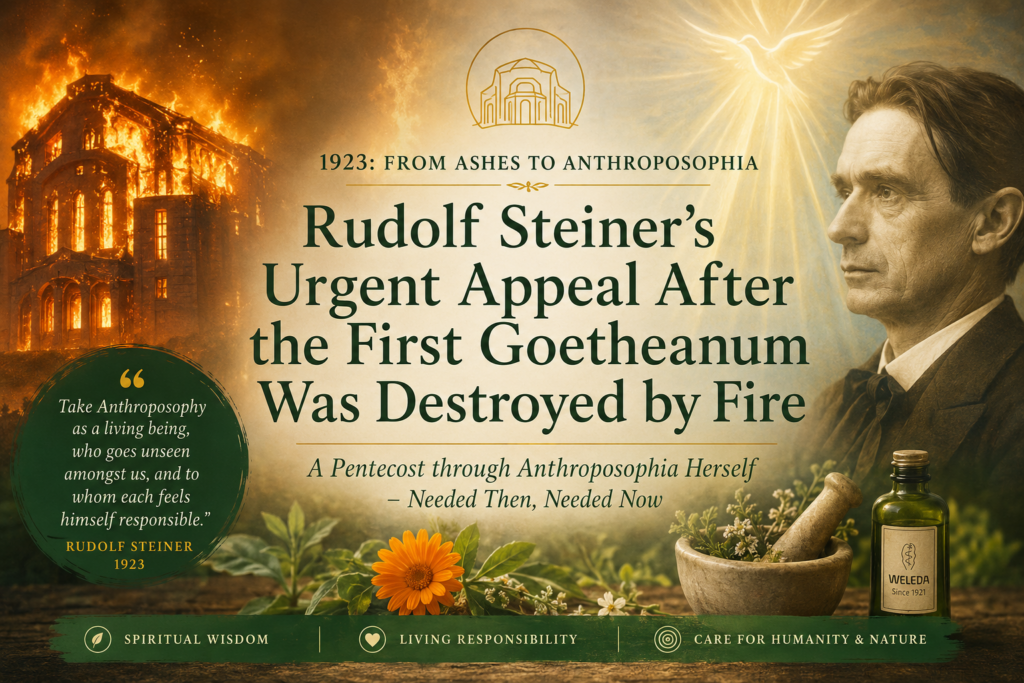
Anthroposophy, Weleda & the Living Spirit From Ashes to Anthroposophia: The First Goetheanum, Pentecost, and the Living Spirit Behind Weleda In 1923, after the First Goetheanum was destroyed by fire, Rudolf Steiner called members of the Anthroposophical Society away from mere outward activity and toward a living connection with the spiritual worlds. That appeal still speaks today — to seekers, gardeners, healers, makers, and everyone who senses that true care must be rooted in spirit as well as nature. Shop my BROOLED Weleda Store Visit my official Weleda Advocate page The First Goetheanum in Dornach before the fire. Image: Wikimedia Commons / public domain. There are moments in spiritual history when an outer event becomes more than an event. A building falls, a community is shaken, and something that once stood visibly in wood, colour, carved form, and shared labour must be rediscovered inwardly. The burning of the First Goetheanum in Dornach on New Year’s Eve 1922/23 was such a moment. For those who had worked, travelled, studied, performed, prayed, and sacrificed around the Goetheanum, the loss was not simply architectural. It was intimate. The building had gathered years of devotion. It had been intended as a home for a new kind of culture: art, science, spiritual research, medicine, education, agriculture, social renewal, and human self-knowledge. When the flames consumed it, they also tested whether anthroposophy could remain alive when its most visible form had disappeared. Rudolf Steiner’s response was striking. He did not ask members of the Anthroposophical Society merely to look outward, rebuild administratively, or be consumed by external opposition. He urged them to forge a connection with the radiant spiritual light of the heavenly worlds. He asked them to relate to anthroposophy not as a doctrine to possess, nor as an organisation to manage, but as a living being: unseen among them, asking for responsibility. That appeal feels powerfully contemporary. We live in a time of constant external noise: notifications, crises, brand activity, organisational busyness, and never-ending commentary. Steiner’s 1923 challenge asks something deeper. Can a movement, a shop, a medicine, a garden, a product, a ritual of care, or a community remain connected to its living spiritual source? Can we still recognise wisdom when the outer container changes? Fire The burning of the Goetheanum was an outer catastrophe, but also a spiritual test for the movement around it. Anthroposophia Anthroposophy was to be taken not merely as teaching, but as a living spiritual presence asking for responsibility. Weleda Weleda belongs to this wider stream: a practical expression of reverence for nature, rhythm, body, soul, and spirit. The Night the Visible Form Was Lost The First Goetheanum had been built in Dornach, Switzerland, through years of remarkable collaboration. It was not designed as a conventional hall. Its rounded forms, double domes, carved columns, painted ceilings, coloured glass, and living sculptural language were intended to make anthroposophy visible. In the Goetheanum, idea and form were not separate. Architecture became a gesture. Art became a path of knowledge. Space became a teacher. The building was destroyed by fire during the night of 31 December 1922 into 1 January 1923. The shock was immense. The Goetheanum had carried the labour of many hands and the hopes of a movement. It was linked with the founding impulses of Waldorf education, biodynamic agriculture, anthroposophic medicine, eurythmy, the arts, and a renewed spiritual understanding of the human being. Yet Steiner’s answer to the catastrophe was not despair. He recognised the pain, but he also pointed beyond the ruin. If the building had been a vessel of love, that love could not be reduced to ash. It had to be sought now in Spirit. What had been outside had to be awakened inside. The ruins of the First Goetheanum after the fire. Image: Wikimedia Commons / public domain. Anthroposophy: Anthropos and Sophia The word anthroposophy is often translated as “wisdom of the human being”. The Greek anthropos points to the human being; Sophia points to wisdom. But the word is richer when approached imaginatively. It suggests that the human being is not complete merely by existing physically, socially, or intellectually. The human being becomes whole by being filled with wisdom — not abstract cleverness, but living, divine, cosmic wisdom. In this sense, the First Goetheanum was more than a cultural centre. It was an attempt to give artistic form to the meeting of Anthropos and Sophia: the human being standing open to cosmic wisdom. Its architecture was not meant to decorate anthroposophy from the outside. It was meant to express a living relationship between the human being and the spiritual worlds. When the Goetheanum burned, the question became unavoidable: had anthroposophy lived only in the building, or could it live in human hearts? Was it a structure, or was it a being? Was it a programme, or was it a responsibility? Steiner’s challenge still matters: external work without inner fire becomes administration. Inner experience without responsible action becomes private mysticism. The living middle is spiritual connection that becomes moral responsibility. Steiner’s Urgent Appeal In January 1923, Steiner spoke with urgency to the members. The Society could not survive merely through outer activity. Rebuilding, fundraising, lectures, committees, and programmes had their place, but they were not the centre. The centre was the inner bond with spiritual reality. That is why his appeal to connect with the radiant spiritual light of the heavenly worlds is so important. He was not recommending escapism. He was not telling people to ignore the world. He was asking them to find the spiritual centre from which meaningful earthly work can proceed. The phrase “living being” is equally significant. To take anthroposophy as a living being means that we do not treat it as a museum, a slogan, or a closed belief system. A living being asks to be met. A living being changes the one who encounters it. A living being asks for care, truthfulness, humility, courage, and devotion. This is perhaps one of the great tests for any
Weleda History: A Century of Holistic Care in the UK

Weleda History: Anthroposophy, Nature, and a Century of Care in the UK For more than a century, Weleda has stood as a quiet but determined pioneer of holistic health. Its story is not simply one of skincare or natural remedies, but of a philosophy made tangible. Weleda’s products are vessels carrying ideas about humanity’s relationship with nature, the rhythms of life, and the possibility of healing through harmony rather than force. In the UK, this story has unfolded for over 100 years, weaving together tradition, innovation, and a deeply human approach to wellbeing. The Founders and the Birth of Weleda Weleda was founded in 1921 by Rudolf Steiner and Ita Wegman, two individuals united by a shared vision of health as a living, spiritual process. Steiner, an Austrian philosopher and social reformer, developed anthroposophy as a path of knowledge that bridges science, art, and spirituality. Wegman, a Dutch physician, sought to bring this worldview into practical medicine, working with therapies that addressed not only symptoms but the whole human being. Together, they imagined a company that would produce medicines and body care products aligned with the laws of nature and the inner needs of the human organism. From the beginning, Weleda was conceived as more than a commercial enterprise. It was an ethical project, rooted in responsibility to the earth, to farmers, to practitioners, and to consumers. Plants were cultivated biodynamically, harvested with intention, and processed in ways designed to preserve their vitality. This philosophy still guides Weleda today. Anthroposophy as a Living Foundation Anthroposophy is often described as “spiritual science,” but at its heart it is profoundly practical. It asks how human beings can live in balance with themselves, with others, and with the natural world. For Weleda, this means creating products that support the skin and body as living systems, rather than attempting to dominate or override them. This approach explains Weleda’s enduring commitment to natural ingredients, biodynamic farming, and ethical supply chains. Plants are not treated as raw materials to be exploited, but as partners in wellbeing. The rhythms of the seasons, the forces of growth and decay, and the relationship between soil, plant, and cosmos are all taken into account. These ideas may sound poetic, yet they result in formulations that feel deeply nourishing and alive on the skin. Weleda’s Journey in the UK: Over 100 Years of Presence Weleda’s presence in the UK stretches back more than a century, reflecting the country’s long-standing interest in complementary medicine and holistic living. Over the decades, Weleda has grown alongside generations of customers who value integrity, transparency, and trust. Through changing fashions in beauty and wellness, Weleda has remained steadfast, never chasing trends but quietly refining its craft. Today, the UK head office is based in Ilkeston, Derbyshire, a location that embodies Weleda’s balance between accessibility and connection to the natural world. From here, Weleda UK coordinates product distribution, education, and outreach, supporting health practitioners, retailers, and customers across the country. The Ilkeston site also symbolises Weleda’s commitment to sustainability and community, acting as a hub for both logistical excellence and human connection. Ethical Sourcing and Biodynamic Cultivation One of Weleda’s defining characteristics is its dedication to biodynamic agriculture. This method of cultivation, inspired by Steiner’s agricultural lectures, treats the farm as a self-sustaining organism. Composting, crop rotation, and natural preparations are used to enhance soil vitality and plant resilience. The result is not only high-quality raw materials, but ecosystems that are healthier and more resilient. Weleda works closely with farming communities around the world, building long-term partnerships rather than short-term contracts. This ensures fair wages, stable livelihoods, and shared knowledge. In an age of mass production and anonymous supply chains, Weleda’s approach feels almost radical in its slowness and care. Skincare as a Relationship, Not a Routine Weleda’s skincare philosophy rests on the idea that skin is a living organ, deeply responsive to inner and outer influences. Stress, nutrition, sleep, emotional wellbeing, and environment all leave their mark. Rather than offering quick fixes, Weleda products aim to support the skin’s own intelligence and capacity for renewal. This is where the role of the Weleda Wellbeing Advisor becomes essential. Products alone cannot tell the whole story. Guidance, listening, and understanding are equally important. As a Wellbeing Advisor, I act as a bridge between Weleda’s philosophy and the individual needs of each person. I am the go-to source for advice, helping customers navigate their choices with confidence and clarity. The Role of the Weleda Wellbeing Advisor Weleda Wellbeing Advisors are trained not just in product knowledge, but in holistic thinking. We listen carefully, taking into account lifestyle, emotional state, and personal rhythms. Recommendations are never one-size-fits-all. Instead, they are tailored, respectful, and rooted in trust. My own journey as a Wellbeing Advisor is deeply connected to anthroposophy and lifelong learning. As a first-class member of the university, I have engaged with anthroposophical study as a living discipline rather than a static philosophy. This grounding informs every consultation, allowing advice to arise from understanding rather than formula. Academic and Professional Foundations My academic path includes a BA and MBA from Brigham Young University, where I developed a strong foundation in both critical thinking and international business. This blend of humanities and practical management provides valuable insight into how ethical companies like Weleda can thrive while remaining true to their values. Alongside academic study, my training as a eurythmist has profoundly shaped my understanding of the human being. Eurythmy, often described as visible speech and song, is a movement art developed within anthroposophy. It works directly with rhythm, gesture, and inner experience, supporting physical, emotional, and spiritual balance. I trained at the London College of Eurythmy and the Vienna Eurythmy School, immersing myself in both artistic and therapeutic approaches. This background enriches my work as a Wellbeing Advisor, allowing me to sense where support is needed and to communicate in a way that feels embodied and authentic. Weleda Today: Tradition Meeting Modern Life In today’s fast-paced world, Weleda offers something increasingly rare: continuity. While the company embraces scientific research